

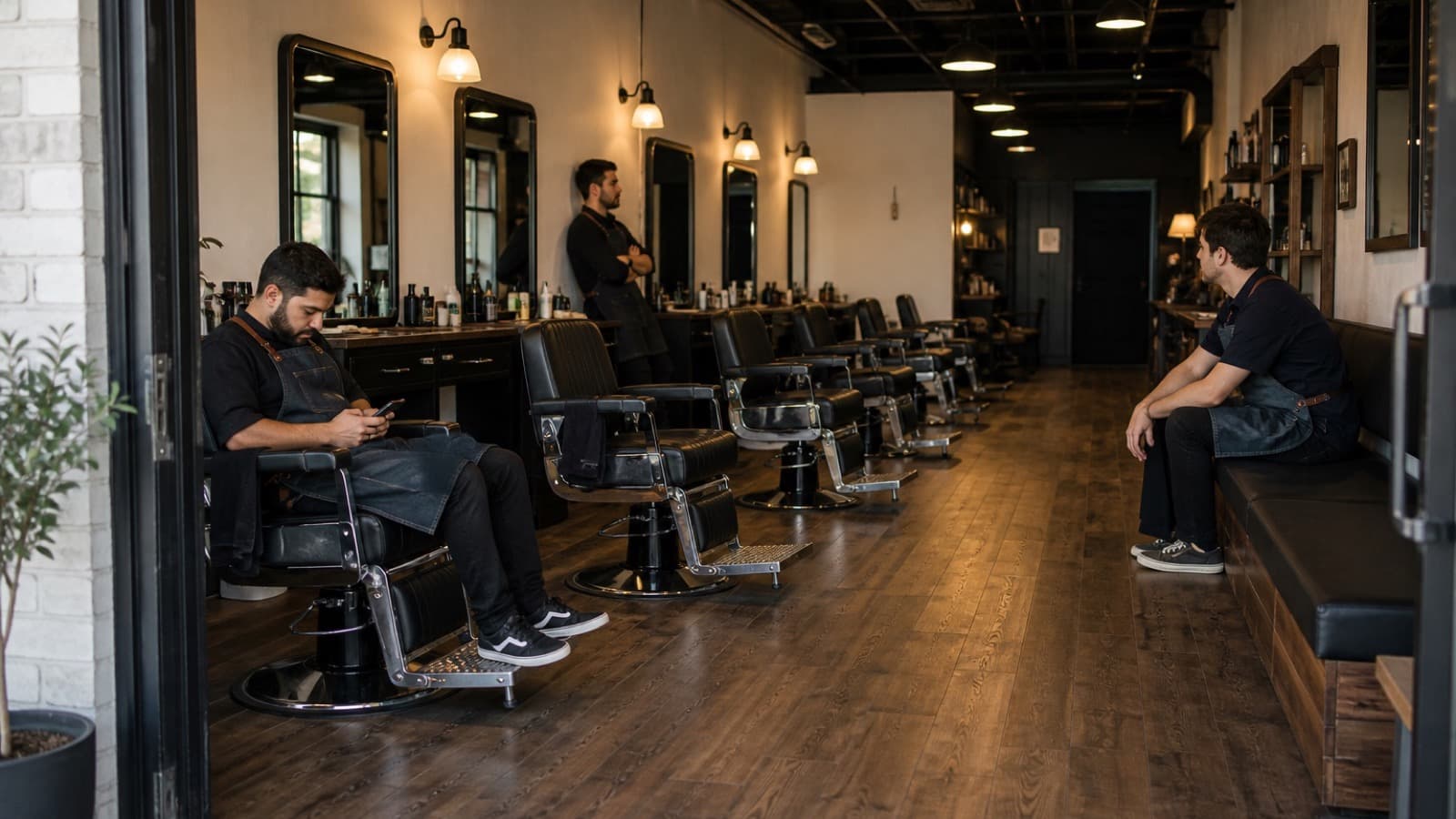
Most of the dead shops I walk into are nice shops.
None of this is about my shops. It comes from shops I worked in before I owned any, shops I have walked into since, and owners I have coached through it. It is almost always the same list.
What I see when I walk in
The plaza is not the best. There is no anchor store. There is not a lot of parking, and it is hard to get into the plaza. Then you go online and the shop is not visible. You go to their website and you don't see a lot of SEO being done, you don't see a lot of keywords. You go to their social media and you don't see a lot of posting being done.
You don't see a brand for barbers, so they can attract barbers. You don't see a brand for customers, so they can attract customers to sit in their barbers' chairs.
And you don't see consistency. They'll promote for a sprint, but they don't run any marathons.
So the list, every time:
- The location is fighting you. Bad plaza, no anchor store, no parking.
- Nobody can find you online. No SEO, no keywords.
- Nothing is getting posted.
- No brand for barbers.
- No brand for customers.
- No consistency.
It is hard when you are competing with so many shops at every intersection. With effort and strategy, you can do it.
The mentality under all six
"I just rent you a chair, you got to figure it out."
How does that serve you as a shop brand? It doesn't. You still got to keep your turn rate down and you still got to keep your chairs rented. You still got to serve people. Imagine having that attitude toward the customers who get their hair cut by you.
That attitude comes from barbers who opened up their own shop but never put on a shop owner hat. They still have a barber's mentality, they just so happen to own a barbershop.
"They're independent contractors. Marketing their book is their job, not mine."
You're right. They're independent contractors. But you have the right to protect your brand.
Part of protecting your brand is making sure you have a reputation as a place where barbers want to work, a reputation where a barber can build a career. In order to do that, you have to have walk-ins. You have to have them.
I don't want to be operating under desperation, where I can only hire barbers who are already booked up. I want to be able to hire anyone because they are good people. That is how you get longevity. It doesn't take that much work to get it, and it is not rocket science to get your shop busy. You just got to put in the effort, and these days you can use online advertising. You can use free social media in a way that serves you regardless, because you should be posting regardless.
"Oh, I don't get a cut of that haircut?" No. But you get rent. And you can always increase rent, because your shop built a great brand and a great reputation, and your shop is in demand by barbers because it is in demand by clients.
I thought the whole point of owning a barbershop was income outside of the chair. With that attitude, you will stay dependent on being behind the chair for a long time.
Or your shop does fine and it stays volatile. One year you might have seven out of ten barbers. Next year there is a walkout and you are down to four. Then you are up to ten, then down to six, then five, then back up to eight. I have seen it a million times.
Why I know it is not the industry
We run ten shops in the Tampa market, competing at the same crowded intersections everybody else is competing at. Across those ten locations we book thousands of cuts a month, and our busiest barbers are running seventy-plus services in a single week.
Nothing about that market is easier than the one you are standing in.
Lead from the front
If you're the shop owner, you should be at the front. Answering the phones. Greeting everyone. On top of your business, behind the chair, mentoring your team. You have to make sure your boat is floating first, and then you start attracting the team you need to scale, if you want to scale. Then the leadership in your brand is not one person everybody depends on. It is a team effort.
A lot of shop owners have a closed mentality where they are afraid to give people leadership roles. They are afraid of depending on other people. They want to do it all themselves. That typically doesn't go well. When people see the results you are getting from being who you are, they start emulating.
I don't know if there's a quote for that or scripture for that, but I'm a Christian. I love Jesus Christ, and I think he would run his businesses this way.
Then make sure your barbers know what marketing and advertising you are running, so they participate in it.
What you do this week
Print a sign and find somebody to hold it out front during peak hours, part-time. It doesn't have to be long. Pay minimum wage, whatever you can afford.
Start actually posting content for the shop, both for clients and to shout out your barbers.
Go to the schools and do some free classes, so barbers learn your brand and know what you are about. Maybe they want to work with you.
Go to events. Set up a booth at tattoo conventions. Work with your local gyms and schools. Run campaigns, print out a whole bunch of flyers, get them handed out, and use your team to do it with you.
Get reviews like crazy on Google, nowhere else for now.
Make sure your website is on point, your Google business profile is on point, and your system is on point.
Keep your barbers informed so they can see and hear about the changes.
Put your best people up front. With the traffic you are about to generate, your best people should be the ones answering the phones, so you can close those leads.
Track everything. If you don't have a system to track everything, get one. I use FullCap. Watch your data and see it grow.
Then, with the new traffic and the new income, you can start running ads. If you have enough traffic coming through the doors already, cheap ads at five or six dollars a day will bring in the barbers you need and help with walk-ins.
A month of that, and nothing obvious happens
You have to be willing to do it for a long period of time. What else are you going to do? What works better? There is no one answer.
If you are tracking everything like you should, you look at the things that are working and you double down on those. Some of them are not going to work as well for you, for whatever reason: demographics, location, whatever it may be. Some of them will work really well. Those are the ones you become a master of, put money behind, and do really well.
It might not happen in two or three months. It might happen in a year, in two years. But it will happen, and any growth is better, because it compounds. What you are doing is stacking small wins and keeping those wins, so you have something to stack on top of. Some people grow, and it is so volatile that they give up faster.
Make it cleaner. Use systems. A lot of what I use these days is the right tools. I don't have fifteen tools scattered all over the place, so I can actually stay consistent and keep a finger on the pulse of my business.
None of it is expensive
None of those six problems is expensive to fix. They are all just decisions nobody made. That is the whole reason an empty shop is usually a solvable problem and not a dying industry.
We are teaching this in a room in Tampa in September at Shop OS Live: three days, the systems we run our shops on, and you leave running on them instead of leaving with notes. The founding rate holds until the doors open on September 21.